Introduction
Death Note is easy to start and surprisingly easy to read in the wrong order. The core manga tells a complete story across 12 volumes, but several guidebooks, one-shots, novels and screen adaptations sit around that main narrative. Some are essential for understanding the original plot; others are optional material that expands the world or revisits its ideas years later.
This guide separates the main manga from its supplementary works, explains where the major one-shots fit, and identifies which books are continuations, companion pieces or entirely different adaptations. It is designed for readers using physical volumes, digital editions or a complete collection such as the Death Note All-in-One Edition.
Spoiler warning: the reading order below discusses the structure of the series and may reveal major developments from the manga.
Quick Answer
For the cleanest first experience, read the works in this order:
- Death Note volumes 1–12, covering the complete 108-chapter manga.
- Death Note 13: How to Read, an official guidebook and reference companion.
- The 2008 special one-shot, commonly called the C-Kira one-shot, if you want a post-series story.
- The 2020 special one-shot, commonly called the A-Kira one-shot, which takes place later in the series’ timeline.
- Death Note: Another Note and L: Change the WorLd, optional novels best read after the manga because they assume familiarity with L and the original investigation.
The pilot chapter, Death Note: The Beginning, is optional and works best as a curiosity after finishing the main series. It is an early version of the concept rather than a required prequel. The Japanese pilot and some supplementary material may be packaged differently depending on the edition or territory.
Main Reading Order
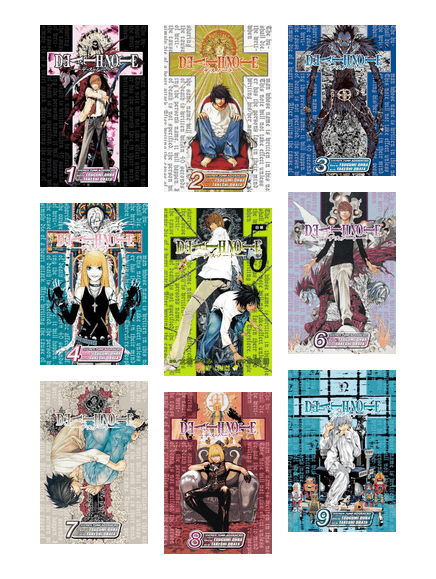
1. Death Note, volumes 1–12
Start with the original manga written by Tsugumi Ohba and illustrated by Takeshi Obata. It follows Light Yagami after he discovers a supernatural notebook that can kill anyone whose name is written inside it, then tracks the escalating conflict between Light and the world’s greatest detective, L.
The story is serialized as a single continuous narrative. There is no need to alternate between volumes, switch to an anime episode guide or insert a novel during the main run. Read volumes 1 through 12 in publication order. The original manga ends in volume 12, and the principal storyline is complete there.
The series is often described in terms of a first investigation and a later investigation, but those sections are still part of the same manga. Stopping at the first major turning point will leave the central story unfinished, so new readers should continue through volume 12 before moving to any supplementary material.
2. Death Note 13: How to Read
Death Note 13: How to Read is not volume 13 of the main plot. It is an official guidebook containing character information, setting notes, explanations of the Death Note’s rules, creator commentary and other reference material. It is useful after the 12-volume story, when the names, rules and investigations are fresh in mind.
Because guidebook contents can vary by language edition, readers should treat it as a companion rather than as a missing chapter of the manga. It may also include short comic material, interviews or extras, but it does not replace any of the 108 main chapters.
3. The later one-shots
After the guidebook, read the later Death Note one-shots in publication order: the 2008 story often identified as the C-Kira case, followed by the 2020 story commonly known as A-Kira. These stories revisit the Death Note in a world that has already experienced the Kira phenomenon, but they focus on new situations and new users rather than simply replaying Light’s story.
They are best approached as optional epilogues. They add perspective to the setting and its rules, but the original ending remains complete without them.
One-Shots and Special Chapters
The pilot chapter
The early pilot chapter, sometimes listed as Death Note: The Beginning, presents a rougher version of the premise. It contains familiar ingredients—the notebook, its supernatural owner and a young protagonist—but the characterization and rules are not identical to the serialized manga.
Read it after the main series if you are interested in how the idea developed. Reading it first can create unnecessary confusion because it is not part of the final continuity in the same way as volumes 1–12.
The 2008 C-Kira one-shot
The 2008 special chapter takes place after the events of the original manga and examines what happens when the Death Note’s influence enters a world that already knows the name “Kira.” Its central idea is less about recreating the original cat-and-mouse game and more about public reaction, imitation and the moral consequences of a supernatural weapon becoming part of social knowledge.
It is often called the C-Kira story because of the name attached to the new case. Naming conventions can differ between translations and fan databases, so readers may encounter slightly different labels. The important distinction is that this is a post-series one-shot, not one of the 108 chapters in the collected volumes.
The 2020 A-Kira one-shot
The later special chapter, usually called the A-Kira one-shot, introduces another person who comes into possession of a Death Note. It is set years after the original story and is interested in how governments, corporations and international politics might respond to the notebook’s existence.
This story is particularly useful for readers who want to see the series’ premise applied to a different kind of protagonist. The new holder does not simply imitate Light, and the resulting conflict depends more on strategy, negotiation and institutions than on a direct repetition of the original rivalry.
Read it after the 2008 story if you want a publication-based order. It can also be read on its own after volume 12, although the older one-shot provides useful context for how the world has changed.
Yonkoma and other extras
Some Death Note collections and guidebooks include short four-panel comics, bonus pages, character notes or promotional material. These extras are not necessary for understanding the plot. They are best treated as optional material to read after the main story, especially because their tone can be much lighter than the psychological thriller itself.
Spin-Offs and Related Works
Death Note: Another Note
Death Note: Another Note – The Los Angeles BB Murder Cases is a prose novel by NisiOisiN, based on the Death Note world and characters. It follows an investigation involving L before the main manga’s Kira case, with Mello serving as the narrator.
The novel is not a manga volume and does not continue the ending of the original series. Its placement is therefore flexible. Chronologically, it concerns an earlier case, but for first-time readers it is safer to read it after the manga. That way, the book’s presentation of L, Mello and the detective’s methods will not distract from the introductions and reveals in the main story.
L: Change the WorLd
L: Change the WorLd is a separate novel connected to the live-action film continuity. It should not be treated as a direct manga sequel. Its story builds on the events and characterization of the Japanese Death Note films, so its best reading position is after watching those films rather than immediately after manga volume 12.
The title is also associated with a live-action film and other tie-in material. Readers should check the edition’s description before buying if they want a prose novel, a movie guide or a film adaptation. The available official movie guide listings are useful for distinguishing companion books from the original manga.
Death Note: Los Angeles BB Murder Cases and the manga timeline
The BB case is sometimes listed in fan timelines before the Kira investigation, but publication order is more practical for most readers. The novel uses knowledge of the wider Death Note cast and setting, and its mysteries work better once the manga’s version of L is familiar.
Community reference pages such as the Death Note Wiki book listings can help identify editions, translations and related publications. They are most useful as bibliographic aids, not as substitutes for the primary manga.
Publication and Chapter Guide
The main series contains 108 chapters collected into 12 tankōbon volumes. English volume subtitles can vary by publisher or listing; the chapter ranges provide the most reliable way to identify where you are in the story.
| Volume | Main chapter range | Reading note |
|---|---|---|
| 1 | Chapters 1–7 | Introduces Light, Ryuk, the Death Note and the first stage of the Kira investigation. |
| 2 | Chapters 8–16 | Expands the investigation and brings new complications into Light’s plan. |
| 3 | Chapters 17–25 | Deepens the conflict between Kira and the investigators. |
| 4 | Chapters 26–34 | Continues the increasingly complex exchange of identities and information. |
| 5 | Chapters 35–43 | Pushes the investigation into a more dangerous phase. |
| 6 | Chapters 44–52 | Contains a major turning point in the central conflict. |
| 7 | Chapters 53–61 | Begins the next large stage of the story. |
| 8 | Chapters 62–70 | Develops the new investigation and its competing strategies. |
| 9 | Chapters 71–79 | Moves the conflict toward its final confrontation. |
| 10 | Chapters 80–88 | Raises the stakes as the opposing plans come together. |
| 11 | Chapters 89–97 | Sets up the endgame. |
| 12 | Chapters 98–108 | Concludes the original manga. |
Collected editions may include volume previews, author notes or bonus pages, and digital services may display chapter titles differently. A complete box set generally refers to volumes 1–12 plus a separate thirteenth book or bonus item, rather than 13 volumes of the main narrative. For example, the commonly listed VIZ box set is described as volumes 1–13 with a premium, while the All-in-One edition presents the 12-volume manga in one large book.
Adaptations and Other Media
The 2006 television anime adapts the main manga storyline and is best watched from episode 1 in broadcast order. It is not necessary to alternate anime episodes with manga chapters. Readers who begin with the manga can watch the anime afterward to compare pacing, performances and visual direction.
There are also Japanese live-action films, a film related to L, stage productions, music releases, video games and other tie-ins. These works do not all share one continuity. The Japanese films tell a version of the story with their own changes, while later international productions reinterpret the premise rather than continuing the manga.
For an adaptation-focused route, finish the manga first, then explore the 2006 anime, followed by the live-action projects. Omangaka’s Adaptations category is the natural place to compare screen versions as more coverage becomes available.
Common Reading Questions
The most common mistake is treating every Death Note publication as part of one uninterrupted manga sequence. The 12 main volumes are the foundation. Death Note 13 is a guidebook, the one-shots are later special stories, and the novels follow their own relationship to the manga or film continuities.
- New to the series? Read volumes 1–12 without interruption.
- Want extra canon-adjacent material? Add Death Note 13, then the 2008 and 2020 one-shots.
- Interested in L? Read Another Note after the manga.
- Interested in the films? Watch the relevant live-action continuity before reading L: Change the WorLd.
- Collecting the series? Check whether a listing contains the main volumes, the guidebook or movie-related extras before assuming “volume 13” means another manga installment.
Why This Guide Matters
Death Note remains a compact series, but its publication history is large enough to make a simple reading order useful. The main manga delivers the complete Light-versus-L story. The guidebook explains and catalogs that world. The one-shots ask what happens when the Death Note outlives its first famous owner, while the novels and adaptations show how differently the same premise can work in another format.
Keeping those categories separate protects the original reading experience. It also lets returning fans choose the material that interests them—case fiction, L-focused stories, later successors or alternate film continuities—without mistaking a companion work for a missing chapter of the manga. For more series-by-series reading advice, visit Omangaka’s Guides section.
References
- Death Note All-in-One Edition Manga Book
- Death Note: Official Movie Guide Book Series
- Category:Books | Death Note Wiki – Fandom
- Death Note Books — a community-created list from …
- Death Note Complete Box Set: Volumes 1-13 with Premium
- Death Note Vol. 1 Overview and Details | PDF | Manga
- Death Note (2006 TV series)
- Death Note
Disclaimer: Information in this article has been compiled from multiple publicly available sources. Details can vary between databases and may change over time. Readers should cross-check important information with official or authoritative sources when needed.
Frequently Asked Questions
What is the correct order to read the Death Note manga?
Read volumes 1 through 12 in numerical order. They contain the complete main story and all 108 chapters. Afterward, read Death Note 13: How to Read if you want reference material and creator commentary.
Is Death Note 13 a real continuation?
No. Death Note 13: How to Read is an official guidebook, not a thirteenth volume of the main plot. It contains reference information, rules, character material and extras.
When should I read the Death Note one-shots?
Read the one-shots after volume 12. For publication order, start with the 2008 C-Kira story and then read the 2020 A-Kira story. Neither is required to understand the original ending.
Is the pilot chapter part of the main continuity?
The pilot is an early version of the concept and differs from the serialized manga in details and characterization. Read it after the main series as an optional piece of development history.
Should I read Another Note before or after the manga?
Read Death Note: Another Note after the manga for the smoothest introduction to L and the wider cast. Although its case takes place before the main Kira investigation, it is designed as supplementary fiction rather than a starting point.
Is L: Change the WorLd connected to the manga?
It is primarily tied to the live-action film continuity, not the manga’s direct timeline. Watch the relevant films first if you want the intended context.
Does the anime have a different reading order?
The anime is watched from episode 1 through its final episode in broadcast order. There is no need to alternate episodes with manga volumes, although comparing the anime with the manga afterward can highlight differences in pacing and presentation.
Can I read the Death Note one-shots without reading the whole manga?
You can, but the later one-shots assume familiarity with the Death Note’s rules, Kira’s legacy and several major events. Reading the 12-volume manga first gives them much more context and impact.